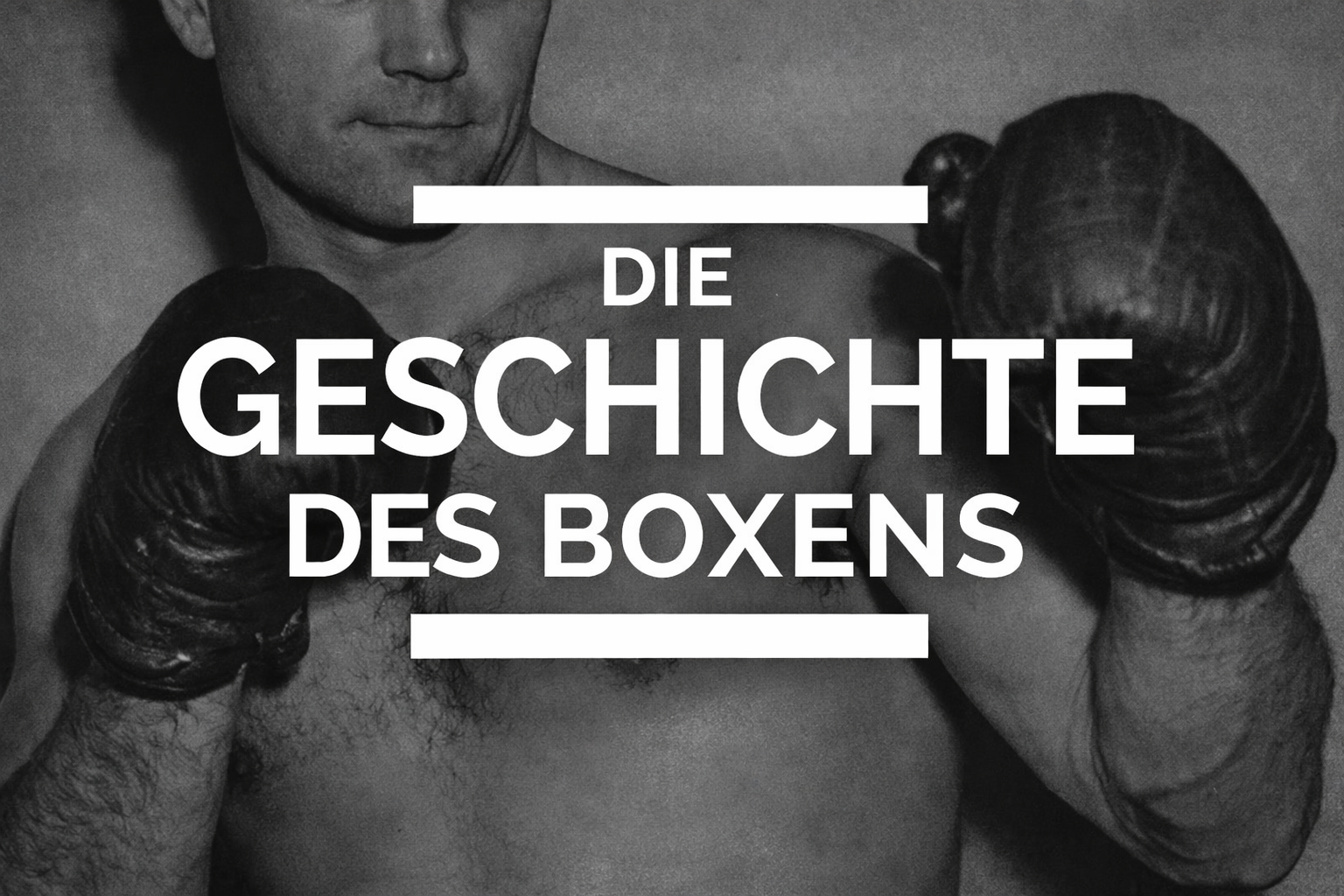
The history of boxing
Boxing is a martial art with a long tradition.
Contrary to what many might think, there are strict rules for this sport. The aim is to land as many hits as possible on the opponent or to put them out of action with a so-called knockout. To minimise the risk of injury, the boxers are equipped with padded gloves and belong to the same weight class. However, the history of boxing, which dates back to ancient Greece, shows that this was not always the case. In the following article, we will take a closer look at the history of boxing from its beginnings to the present day and trace the development of boxing.
The beginnings of boxing
Man-to-man competitions have probably existed since the dawn of mankind, but the beginnings of organised pugilism can "only" be traced back to the Greek Olympic Games in 688 BC. Researchers have discovered that the first fistfights for entertainment purposes were held in Egypt as early as 3000 BC. However, these fights were usually not subject to any rules and were not considered a sport, but a fight to the death. Pugilism only achieved the status of a recognised sport in Ancient Greece. From this time onwards, there were also set rules for fighting in the ring. Nevertheless, this ancient form of boxing had little to do with today's boxing matches.
Further development of boxing - boxing in modern times
The origins of modern boxing lie in England, with the sport experiencing its greatest boom and most significant development in the 17th and 18th centuries. In 1681, the Duke of Albemarle organised the first recorded boxing match. Due to its great success and increasing spectator interest, boxing events were held regularly in London's Royal Theatre from this year onwards. However, even this form of boxing cannot be compared with today's fights. Back then, the hands were not bandaged and the knuckles were exposed. This was known as bare-knuckle boxing. Bare-knuckle boxing is now no longer legal due to the high risk of injury, but is still often carried out illegally underground in many countries such as Great Britain, Ireland, the USA and Eastern Europe. The first boxing rules of the modern era were drawn up by fencing master James Figg. He won the first major boxing tournament of modern times in 1719 and was henceforth able to call himself the "Boxing Champion of England". It was not until 1743 that the great set of rules for boxing - the Broughton Rules - was published. This set of rules contained new revolutionary principles. For example, you were no longer allowed to hit an opponent who was lying on the ground, and low blows were also prohibited. A few years later, in 1838, an even more comprehensive rulebook was published with the name London Prize Ring Rules. The most important innovations were the introduction of the boxing ring and the obligation to bandage the hands in order to minimise the risk of injury.
A sensational fight, which also played a major role in the regulation of boxing, took place on 17 April 1860 in Farnborough. The English heavyweight champion Thomas Sayers and the younger, but taller and heavier, American John Carmel Heenan (known as "The Benicia Boy") competed against each other. The fight was stopped after no less than 37 rounds and around 140 minutes of fighting time as the crowd stormed the ring. The fight was scored a draw and led to the passing of the "Anti-prize Fight Act", which banned the holding of illegal championship fights and fights without rules. Particular opposition to this law came mainly from the English upper classes.
Modern boxing
From 1892, boxing was only practised with boxing gloves. After the Second World War, many new rules were added to protect boxers who were injured or knocked down. The boxing gloves used also underwent enormous changes over the years. The 1904 Olympic Games in St. Louis were the first modern games to allow boxing as an Olympic discipline. In Germany, the first official boxing club, SC Colonia 06, was founded in 1906.
Boxing and training
Boxing training has also changed enormously over the course of time. In the past, training was mostly done without training equipment and increasingly in sparring. Today, training is much more balanced and specialised. Today, not only strength is trained, but also endurance, coordination, stamina and footwork.
Training with a punching bag or punching ball in particular has become one of the most popular training methods in modern times. Since the first boxing clubs were founded at the beginning of the 20th century, punching bags in particular have been widely used as new training equipment and are still very popular today. These training devices have now also become very popular in gyms or for training at home. When it comes to punching bags, the most important factors are the right size and the right weight, as well as a high-quality fastening, hard-wearing outer material, a customised filling and high-quality workmanship. Retro-style punching bags in particular (from the beginning of the 20th century) are very popular again, as they are usually made from high-quality cowhide and are painstakingly handcrafted. Back then, punching bags were also closed with the help of a lacing and not a zip.




Comments (0)