Squats - execution & technique
Squats - What you need to know about the king of bodybuilding exercises!
Athletes love and hate the squat at the same time. They love it because there is probably no more effective exercise for building a stable core, thick thighs and a firm backside. It is hated because the squat is very strenuous due to the immense number of muscle groups involved in the movement and also challenges the cardiovascular system as well as the muscles themselves. It is also hated because the squat is one of the most difficult and insidious exercises of all, and has already caused a number of exercisers to suffer a slipped disc or related knee problems. It is important to deal with this dual role in the best possible way, which is why today's article provides everything you need to know about the squat and shows how you can protect yourself from injury despite high training weights and high intensity.
Probably the most hated, but also the most effective exercise in weight training should not be missing from any training plan, regardless of whether the training goal is muscle building, definition or fat burning.
This is the squat!
Muscle groups involved
The classic squat is mainly used to strengthen the thigh muscles. In reality, however, it involves more muscles (primary or secondary) than any other exercise, as the attached list shows:
The squat is therefore an exercise that puts our gluteal muscles, the entire thigh muscles (front and back), our calf muscles and the back extensor muscles through the wringer, as well as several other auxiliary muscles in the ankle joint, spinal stabilisers and, of course, the abdominal muscles.
Conclusion
No exercise utilises as many muscles and auxiliary muscles as the free knee bend
Execution
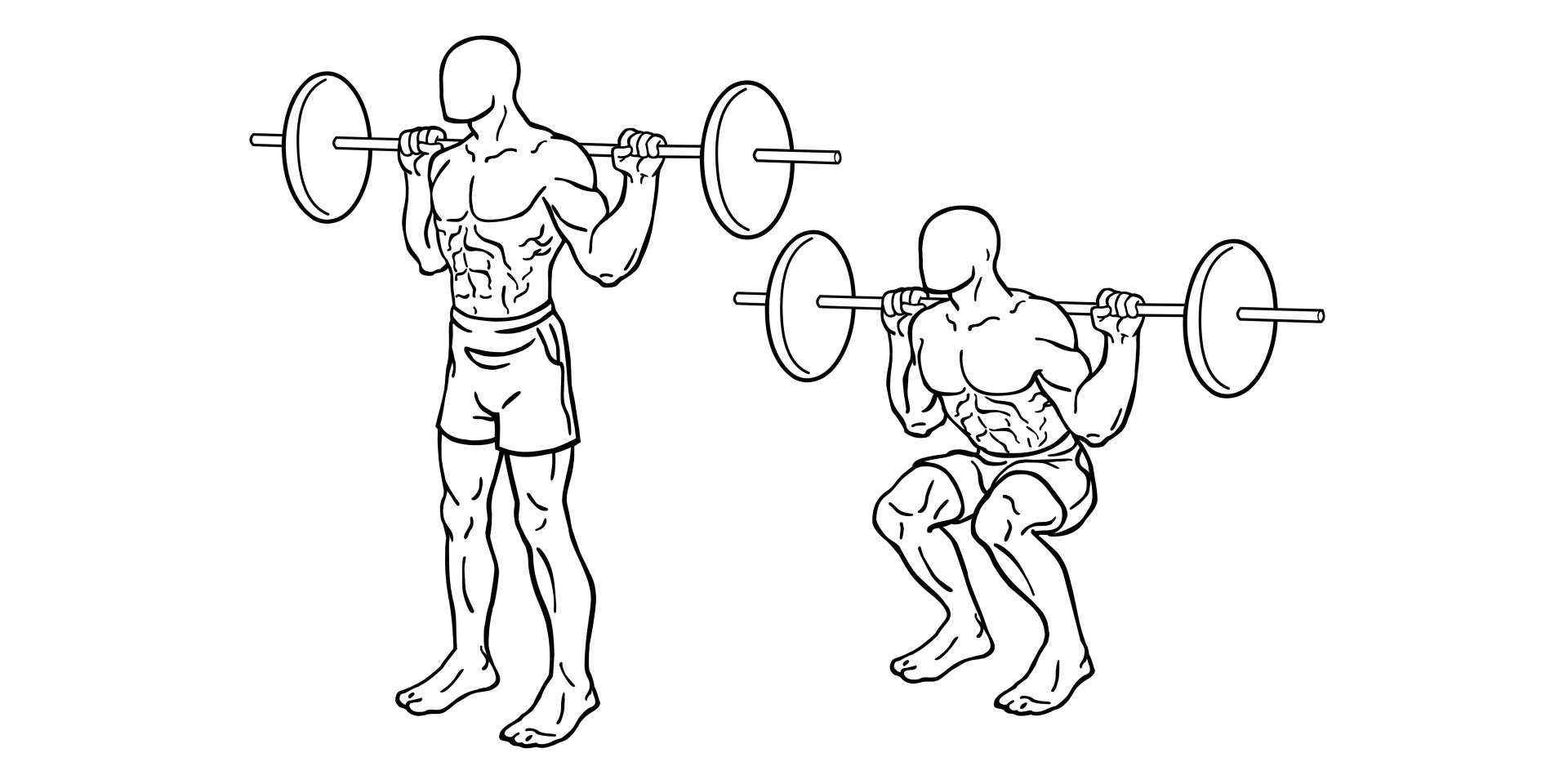
For the free squat, you need nothing more than a squat stand, a barbell and an appropriate amount of disc weights. When starting the exercise, the most important thing is to pick up the bar correctly first. In the standard squat, the bar should ideally rest on the hooded muscle (trapezius) and not on the 7th cervical vertebra as is often done incorrectly. If the bar causes you pain despite the correct support position, you can use a pad. It is important that you do not lose your feeling for the weight and the bar despite this aid. With a straight back, the bar is now removed from the holder while you get into the starting position for the work set. Stand with your feet slightly wider than shoulder-width apart and in a very slight V-stance, with your centre of gravity resting on the entire sole of your foot, your knees straight and the tips of your feet pointing in the same direction as your knees.
Important
If you are unable to perform a full squat with this stance, you may still have a mobility problem for the perfect squat, which needs to be resolved before working with very heavy weights
For the perfect squat, look straight ahead and remain in this position throughout the exercise. During the downward movement, the buttocks are now lowered as far back as possible. The knees should be consciously pushed outwards during the movement to avoid an X position. Once you reach the lowest point of the movement, you should immediately return to the upward movement without pausing (static phase); it is important here that the gluteus acts as the initiator of the upward movement. In the end position, the knees should never be fully extended in order to avoid additional strain being placed on the joint rather than the muscles. During the entire exercise, the core should be fully tensed and the weight 100% controlled, and any swinging from the back or leaning forwards or backwards should be avoided. A squat is performed with a straight back in every phase of the movement.
Of course, you can also perform guided squats in a multi-press or other equipment. The advantage of this is that the exercise is slightly less demanding, but it is also the biggest disadvantage, as it deprives you of the coordinative training effect of the exercise and a number of auxiliary muscles are not trained in the same way as in the free version.
That's why you should never do without squats!
Often hated, but no other exercise is as effective as the supreme discipline of the squat. We show you why the squat exercise should not be missing from any proper training plan, regardless of whether your goal is muscle building, definition or fat loss.
Muscle building & strengthening of the entire thigh muscle
Knack-Po guarantee
Strengthening the core muscles
Increased fat burning
High calorie consumption
Improvement in hormone production (u.a. Growth hormones and testosterone)
Effective balance training
Improved posture by strengthening the lower back muscles
Very good cardiovascular training
Conclusion
If you're going to do squats, then do the free version, even if there are a few things to consider when doing them.
We recommend wearing a belt with every basic exercise, especially for women! For example: Shiek Lifting Belt




Comments (0)