Ashwagandha benefits, dosage and side effects
This complete guide will cover everything you need to know about ashwagandha. Learn how supplementing with this herbal ingredient can help you achieve your fitness goals.
What is ashwagandha?
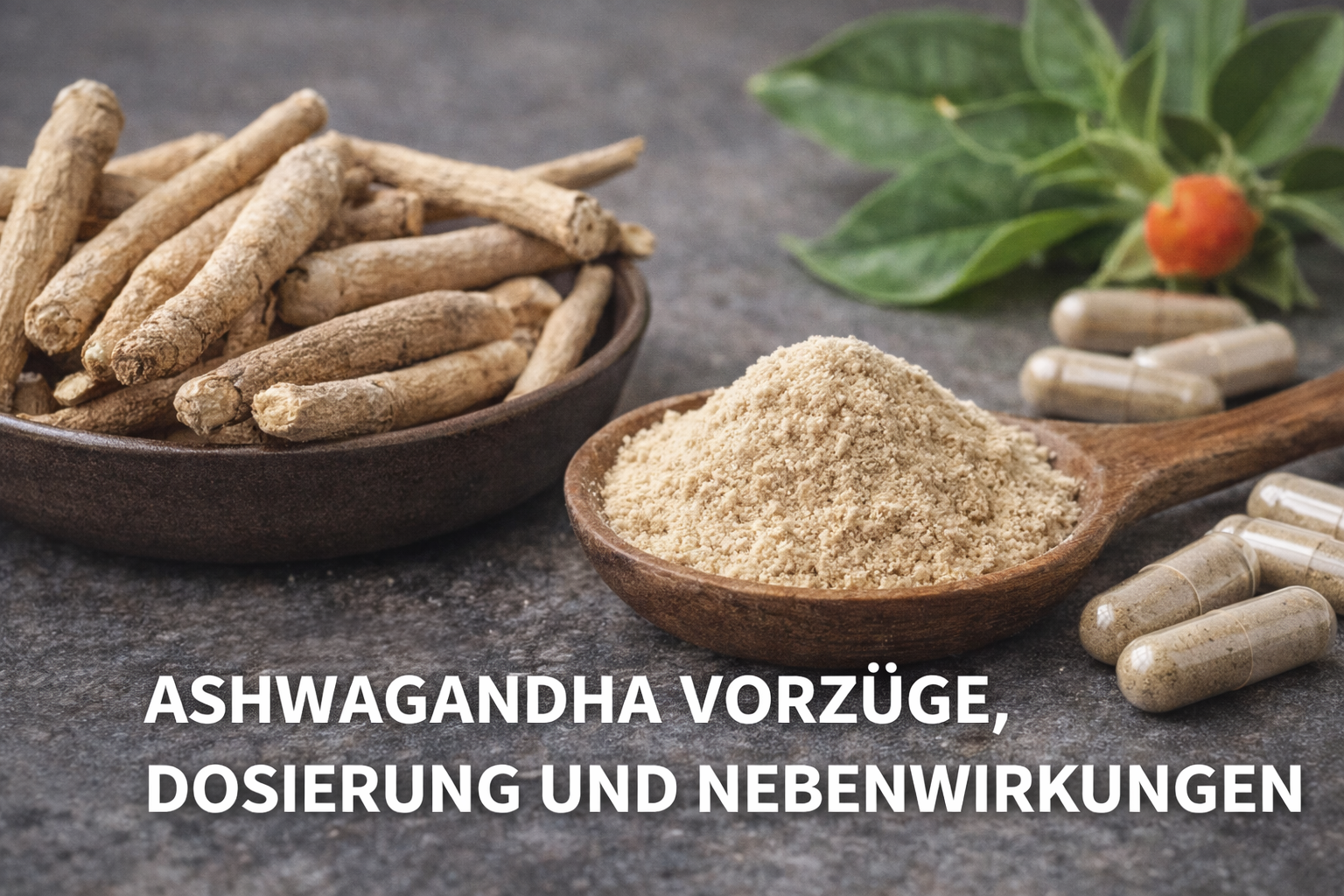
Ashwagandha is an adaptogenic medicinal plant from the field of Ayurveda (an ancient branch of Indian herbal medicine) that is extremely effective in helping the body deal with anxiety and stress.
Traditionally, ashwagandha was used to help revitalise the immune system after illness. Today, ashwagandha is used to treat a range of conditions including arthritis, depression, insomnia, asthma, bronchitis and chronic liver disease.
In Sanskrit, ashwagandha means 'smell of horse', which refers to the traditional belief that consuming this plant can give you the strength and potency of a stallion. However, traditional beliefs aside, there are over 300 published scientific studies on ashwagandha and there is plenty of evidence to support the fact that this plant is an all-round superfood.
The anabolic effects of ashwagandha
Ashwagandha and cortisol
Cortisol is a steroid hormone that is released by the body during periods of physical and/or emotional stress. Its function is to help the body mobilise its energy reserves in muscle tissue. In other words, cortisol is a catabolic hormone.
The more cortisol flows through your veins, the less your body is able to remain in the anabolic state needed to build muscle. The best known effect of ashwagandha is its ability to significantly lower cortisol levels. In one study, 64 subjects (42 men and 22 women) with a history of chronic stress were randomly assigned to a group that received a daily dose of 600 mg ashwagandha root extract or a group that received only a placebo (1).
Blood samples were taken before the start and after 60 days of the study. On day 60, the subjects who had received ashwagandha had on average 20% lower cortisol levels compared to the members of the placebo group.
Cortisol has an inverse relationship with the primary male muscle-building sex hormone, which means that the higher the cortisol levels, the lower the levels of this muscle-building hormone. Ashwagandha is therefore not only anti-catabolic, but also has the effect of increasing the production and release of muscle-building hormones.
Ashwagandha and the levels of muscle-building hormones
As you probably know, the male sex hormone is also the primary hormonal driver of muscle growth. The more of this hormone you have in your body, the better your muscles will be able to regenerate after training and the faster they will grow as a result. This hormone is therefore a necessary component in your quest for muscle mass and strength.
A daily dose of 5 grams of ashwagandha root powder was sufficient to increase the production of the primary muscle-building male sex hormone by 13 to 22% within 3 months in infertile men (2). These results were replicated in another study in which infertile men were given 3 grams of ashwagandha root extract (instead of root powder) over a 3-month period. In this study, increases in the levels of the primary muscle-building male sex hormone of 14 to 41% were observed (3).
However, the truly outstanding results are achieved when ashwagandha intake is combined with resistance training.
Healthy male volunteers aged 18 to 50 years with limited exercise experience were randomly assigned to either a group that received a daily dose of 300 mg ashwagandha root extract over an 8-week period or a group that received only a placebo (4). During the eight-week study period, the subjects also performed resistance training three times a week. The levels of the primary muscle-building male sex hormone increased by an average of 15.25% in the ashwagandha group.
In the placebo group, this increase was only 2.6%. But the really interesting results were the strength gains observed. The members of the Ashwagandha group were able to increase their maximum bench press weight by an astonishing 138%. In the placebo group, this value was only 84%. In addition, the members of the Ashwagandha group were able to increase their leg extension strength by 52%, while the members of the placebo group only recorded strength gains in the region of 38%.
And to put the icing on the cake, members of the ashwagandha group lost more than twice as much body fat as members of the placebo group (3.47% vs. 1.52%). All of these results are quite astonishing and show that ashwagandha is a powerful supplement that can significantly increase levels of muscle-building hormones.
Ashwagandha and muscle growth
As mentioned earlier, the subjects in the above study who supplemented with ashwagandha showed significant gains in strength as measured by their 1RM weight on bench press and leg extensions. However, I have not yet mentioned that these subjects in the ashwagandha group also achieved 38% greater gains in arm circumference and 57% greater gains in chest muscle mass compared to the placebo group.
In addition, the ashwagandha group showed significantly reduced markers of exercise-induced muscle damage.
In another study, 18 healthy volunteers were given increasing doses of ashwagandha over a period of 30 days (5):
- Day 1 to 10: 750 mg/day
- Day 11 to 20: 1000 mg/day
- Day 21 to 30: 1250 mg/day
Before starting the 30-day supplementation programme, the scientists determined muscle strength by measuring grip strength, quadriceps strength and back extensor strength. Within the 30-day study period, the test subjects were able to increase their grip strength by an average of 8%, their quadriceps strength by an average of 21.5% and the strength of their back extensors by an average of 15.4%.
These results are quite impressive when you consider that they were achieved without the test subjects completing any training programme.
The health benefits of ashwagandha
Ashwagandha and heart health
Supplementation with ashwagandha has been shown to significantly reduce LDL cholesterol levels (5). LDL cholesterol is often referred to as "bad" cholesterol as it contributes to the accumulation of fat stores in the arteries. Ashwagandha has also been shown to lower triglyceride levels (6) and improve blood pressure (7).
All these factors significantly improve heart health and reduce the risk of developing cardiovascular diseases and strokes.
Ashwagandha and brain health
Any type of stress - whether it is physical, emotional or chemical stress - can seriously damage the brain. Scientific research has shown that ashwagandha is more than just a stress reliever. Ashwagandha can protect the brain from degeneration and Alzheimer's disease (8, 9) and relieve anxiety (10).
Approximately 3.3 million Americans have been diagnosed with depression. Ashwagandha is able to alleviate the symptoms of depression (10) and improve overall well-being by reducing cortisol levels in the body (7).
Haemoglobin is a protein found in red blood cells that transport oxygen throughout the body. Ashwagandha supplementation has been shown to increase haemoglobin levels (7). This means more efficient oxygen transport, which in turn can increase energy levels and improve overall well-being.
Ashwagandha and blood sugar levels
Elevated blood sugar levels over a long period of time can lead to serious health problems ranging from heart disease and stroke to kidney disease and nerve problems.
Scientific studies have shown that ashwagandha can effectively lower blood sugar levels (11).
Ashwagandha and infertility
Ashwagandha supplementation can be particularly beneficial for men suffering from infertility.
Scientific studies have shown that ashwagandha supplementation can significantly improve various parameters of sperm quality (12). One study came to the conclusion that ashwagandha supplementation increased the fertility rate by 15% (13).
Does ashwagandha have any side effects?
As with any other supplement, it is important to consult a doctor before using ashwagandha. The long-term effects of supplementation are not known, but some known side effects include stomach problems such as diarrhoea and vomiting.
Ashwagandha can also lower blood sugar levels. In diabetics, the effect of diabetes medication could be intensified and result in blood sugar levels that are too low. Diabetics who decide to use ashwagandha should therefore monitor their blood sugar levels closely.
As ashwagandha can also lower blood pressure, people suffering from low blood pressure should be careful when using ashwagandha.
Who should consider supplementing with ashwagandha?
You can consider using ashwagandha if you:
- Are under a lot of stress.
- Are you looking for a natural way to increase your normal production of muscle-building male sex hormones?
- Want to improve your libido efficiently.
- Try to break through a training plateau.
Avoid ashwagandha if you do:
- Are pregnant.
- Suffer from diabetes.
- Are taking blood pressure medication.
- Suffer from stomach ulcers.
- You are about to have an operation.
How should you take ashwagandha?
Lowest effective dosage for acute use: 300-500mg.
Optimum dosage: 6.000mg/Tag divided into 3 single doses of 2,000 mg each.
Ashwagandha should be taken with meals. If taken once a day, it should be taken with breakfast.
Whether in powder or capsule form, the preferred form of ashwagandha is a root extract.
The active ingredients contained in ashwagandha are flavonides, known as withanoids. An ashwagandha supplement worth its salt should contain at least 4% withanoids.
References
Chandrasekhar, K., et al. "A Prospective, Randomised Double-Blind, Placebo-Controlled Study of Safety and Efficacy of a High-Concentration Full-Spectrum Extract of Ashwagandha Root in Reducing Stress and Anxiety in Adults." Indian Journal of Psychological Medicine, Medknow Publications & Media Pvt Ltd, 2012.
Mahdi, Abbas Ali, et al. "Withania somnifera Improves Semen Quality in Stress-Related Male Fertility." Evidence-Based Complementary and Alternative Medicine : eCAM, Hindawi Publishing Corporation, 2011.
Ahmad, M K, et al. "Withania somnifera improves semen quality by regulating reproductive hormone levels and oxidative stress in seminal plasma of infertile males." Fertility and sterility.., U.S. National Library of Medicine, Aug. 2010.
Wankhede, Sachin, et al. "Examining the effect of Withania somnifera supplementation on muscle strength and recovery: a randomised controlled trial." Journal of the International Society of Sports Nutrition, BioMed Central, 2015.
Raut, A A, et al. "Exploratory study to evaluate tolerability, safety, and activity of Ashwagandha (Withania somnifera) in healthy volunteers." Journal of Ayurveda and integrative medicine, U.S. National Library of Medicine, July 2012.
Agnihotri, Akshay P., et al. "Effects of Withania somnifera in patients of schizophrenia: A randomised, double blind, placebo controlled pilot trial study." Indian Journal of Pharmacology, Medknow Publications & Media Pvt Ltd, 2013.
Auddy, B., et al. "A Standardised Withania Somnifera Extract Significantly Reduces Stress-Related Parameters in Chronically Stressed Humans: A Double-Blind, Randomized, Placebo-Controlled Study." The Journal of the American Nutraceutical Association, November 2008.
Bhattacharya, A, et al. "Anti-oxidant effect of Withania somnifera glycowithanolides in chronic footshock stress-Induced perturbations of oxidative free radical scavenging enzymes and lipid peroxidation in rat frontal cortex and striatum." Journal of ethnopharmacology, U.S. National Library of Medicine, Jan. 2001.
Sehgal, N, et al. "Withania somnifera reverses Alzheimer's disease pathology by enhancing low-density lipoprotein receptor-Related protein in liver." Proceedings of the National Academy of Sciences of the United States of America, U.S. National Library of Medicine, 28 Feb. 2012.
Andrade, C, et al. "A double-Blind, placebo-Controlled evaluation of the anxiolytic efficacy ff an ethanolic extract of withania somnifera." Indian journal of psychiatry, U.S. National Library of Medicine, July 2000.
Andallu, B, and B Radhika. "Hypoglycemic, diuretic and hypocholesterolemic effect of winter cherry (Withania somnifera, Dunal) root." Indian journal of experimental biology, U.S. National Library of Medicine, June 2000.
Ahmad, M K, et al. "Withania somnifera improves semen quality by regulating reproductive hormone levels and oxidative stress in seminal plasma of infertile males." Fertility and sterility, U.S. National Library of Medicine, Aug. 2010.
Mahdi, Abbas Ali, et al. "Withania somnifera Improves Semen Quality in Stress-Related Male Fertility." Evidence-Based Complementary and Alternative Medicine : eCAM, Hindawi Publishing Corporation, 2011.



Comments (0)