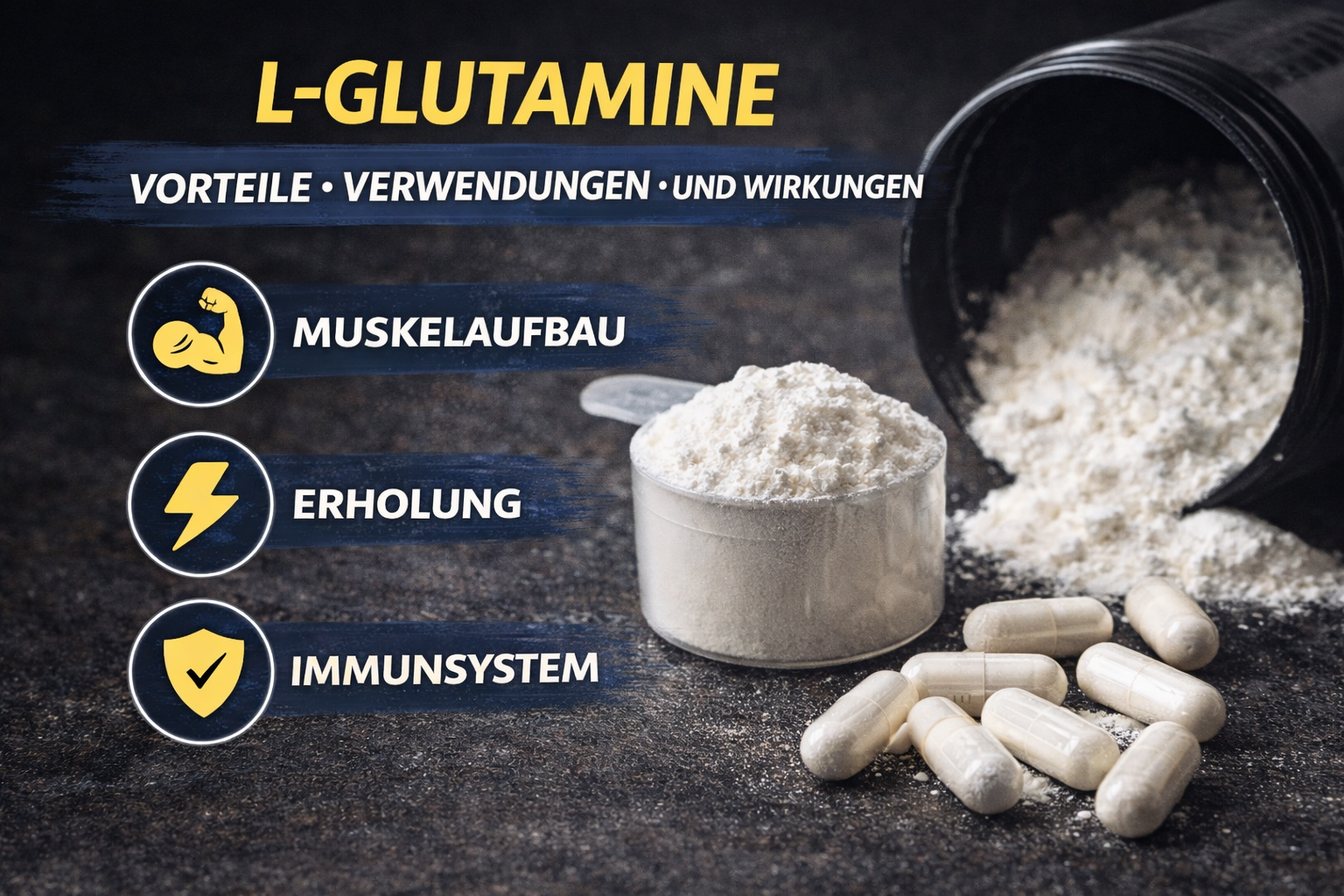
It is said to strengthen the immune system, build muscle and support regeneration after training - the amino acid L-glutamine is considered a miracle cure. But what's the truth? Does the glutamine hype deliver what it promises? Let's take a closer look at this all-rounder.
L-glutamine - what is it actually?
L-glutamine is an amino acid that your body needs for muscle building and regeneration. As an amino acid, it is one of the smallest protein building blocks in our body, which in turn consists of proteins. And it is precisely these proteins that are indispensable for the production of new muscle mass.
L-glutamine is semi-essential. In other words, the body produces it itself, but you can also get it from your diet. After all, the body's own reserves are not always sufficient. The body's stores quickly reach their limits, especially during heavy physical and mental exertion, for example during training, illness or increased stress levels. The body's own glutamine synthesis can no longer cover the increased requirement and supplements have to step in.
How does L-glutamine work?
L-glutamine is often touted as an all-rounder - and rightly so. After all, it is actively involved in several metabolic processes. Above all, it has a hand in the acid-base balance, the regulation of cell volume, the control of balance and the metabolism of protein, fat and carbohydrates. Especially in regeneration!
It is also welcome in your immune system - for good reason. L-glutamine is an essential nutrient for immune cells. Especially in stressful situations, your battered organism is grateful for its glutamic acid reserves. They keep the body's defences on their toes even under heavy strain.
The same applies to detoxification. Glutamic acid reliably boosts the body's natural detoxification process, the breakdown of ammonia. Digestion is no different. If your body suffers from a lack of L-glutamine, your intestinal mucosa suffers from a limited energy supply.
L-glutamine, a reliable everyday helper
As this powerful amino acid is involved in many metabolic processes, it is considered indispensable for our daily well-being. We can make particularly good use of it
- as a gentle booster for muscle building
- to support healthy and restful sleep
- as a calming agent in stressful situations
- as a natural aid to concentration and memory
How much glutamic acid do we need?
There is no universal recipe for the daily dose of glutamic acid. Each person has their own individual requirements. And this depends on various factors:
- Age
- State of health
- current life circumstances such as stress levels and physical exertion
Experts estimate the average requirement of an adult to be around 10 grams per day. For competitive athletes, the recommendations are significantly higher: Up to 40 grams a day is appropriate.
Where does our body get glutamic acid from?
The main sources of glutamic acid are protein-rich foods such as poultry, tuna, pollock, carp, prawns, soya beans, pulses and cheese (Emmental and cheddar). Spirulina, oatmeal, milk and green tea are also at the top of the menu. And don't forget plenty of fresh vegetables. Carrots and radishes in particular reliably replenish depleted glutamic acid stores. The top recommended foods include (per 100 grams)
- Cheddar with 700 mg
- Ham with 670 mg
- Turkey with 630 mg
- a glass of milk with 580 mg
When do I need more glutamic acid?
Good news: Normally, your glutamic acid balance is self-sufficient. If you eat a healthy and balanced diet, you are on the safe side. But there are exceptions. Sometimes our body needs external support. It is particularly reliant on us:
- Competitive sport and hard physical labour
- Stomach ulcers and chronic indigestion
- inner restlessness and nervous tension
- increased alcohol consumption
- heavy physical strain such as operations, illnesses and injuries
However, you do not have to accept the deficiency. Food supplements relieve your body in exceptional situations - but not just any food supplements. It's the quality that counts. Supplements from Viking are a good choice. Whether in powder or capsule form, these high-quality supplements will boost your performance without being a burden. They are a reliable partner, especially during training.
Glutamic acid, the insider tip for athletes
For more energy after training
Athletes have long since discovered glutamic acid for themselves. They swear by the natural energy kick, especially for regeneration after training. It is not without reason that you feel fit again more quickly after a workout. The regenerative effect plays into your hands, especially when training at a high frequency. This is made possible by the rapid replenishment of glycogen stores, which your body produces on its own and stores mainly in the muscle cells. It is not for nothing that glycogen is considered an essential source of energy for exceptional physical performance. However, when the body's own glycogen stores run low, so do the energy reserves during training.
And this is exactly where glutamic acid comes into play. According to scientific studies, it successfully boosts glycogen storage after training. Your body is ready for the next workout more quickly. Athletes who exercise daily or several times a week particularly appreciate the rapid regeneration.
For a strong immune system
Everyone can use a strong immune system, especially athletes. Especially after long and exhausting training sessions, the so-called open window syndrome can quickly set in. The body has exhausted itself and infections have an easy time of it. Glutamic acid comes at just the right time: it has been proven to reduce the risk of illness.
A scientific study with marathon runners provides solid proof of this: In athletes who took supplements, the risk of illness was reduced by up to 50 %*.
Less muscle loss
Why work so hard if you lose the muscle mass you have painstakingly built up? Glutamic acid as a dietary supplement stops this annoying phenomenon. It prevents the body from gaining energy from the body's own protein, i.e. muscle mass, after intensive periods of exertion. You retain your training results.
Science has already been able to prove the positive effect: Test subjects who regularly consume glutamic acid broke down less muscle protein in stressful situations. Their muscle mass remained virtually untouched*.
When should I take glutamic acid?
It is best to take glutamic acid on training days, immediately during or after physical exertion. The optimum dosage is an average of 10 grams. On non-training days, 5 to 10 grams before going to bed is recommended.
5-10g before training
5-10g after training
5-10g before going to bed. L-glutamine stimulates the body's own growth hormone production at night.
When do I feel the effects of glutamic acid?
The effect of glutamic acid is immediate. Immediately after ingestion, the active ingredient boosts both the immune system and glycogen storage. An example: If you consume glutamic acid after an extended circuit training session or a strenuous long-distance run, you are doing your immune system a favour. Just a few minutes after ingestion, your glutamic acid levels will rise and replenish your depleted glycogen stores. The energy returns.
_________________________________________________________________________
*1 Lacey/Wilmore: Is glutamine a conditionally essential amine acid? Nutritional review, pp. 297-309, 1990
*2 Castell/Newsholme/Poortmans: Does glutamine have a role in reducing infections in athletes? European journal of applied physiology, pp. 488-490, 1998
The text of the article is subject to the author's copyright and may not be used by third parties!






Comments (0)