Differences in mouthguards
In all sports that are even remotely related to boxing, Thai boxing,MMA andKickboxing are related, wearing a mouthguard is usually mandatory for athletes. There is an obvious reason for this: teeth can break or even fall out in the event of kicks (such as in Muay Thai and kickboxing) or punches to the face. These injuries are not only extremely painful, but can also be irreparable.
AMouthguard - actually more correctly referred to as a mouthguard - protects against such injuries. This is done in a very simple way: The mouthguard consists of a plastic splint that is worn over the teeth and stabilises their shape. The mouthguard remains in position even when the jaw and teeth are subjected to mechanical stress.
In this blog post, we present all the important aspects of mouthguards in sport and also showcase some mouthguard models.
Why should I wear a mouthguard for martial arts?
The use of aMouthguard is of great importance, not only to protect and stabilise the teeth, but also the upper and lower jaw. Another advantage is controlled breathing during training, which is particularly important in competitions. For this reason, it is advisable to wear the mouthguard during training to get used to it and facilitate even breathing. It is often argued that a mouthguard is only necessary for hard blows, but even light blows can cause painful damage. Anyone who has ever been hit without a mouthguard knows how painful this can be. A well-fitted mouthguard is comfortable to wear and does not interfere with breathing. It is therefore advisable to always wear a suitable mouthguard during both training and competition in order to avoid injury. Cheap protective equipment should be avoided as it often does not offer the necessary protection. A high-quality mouthguard is an investment in your own health and safety. There are different types of mouthguards, such as customised or pre-shaped models. Customised guards are made by a dentist and adapt perfectly to the shape of your own teeth. Pre-moulded models are already shaped and can be adjusted by heating them in a water bath.
So if you play sport regularly, you shouldn't go without a suitable mouthguard. A small investment can prevent major health consequences and help you to pursue your sporting activities with peace of mind.
How the mouthguard works in boxing
A mouthguard is essential to prevent injuries in the mouth area. It is important that the material of the mouthguard is shock- and impact-absorbent. Mouldable and soft materials that can absorb energy in the event of an impact are particularly suitable. If the upper and lower jaws are pressed firmly together, the impact energy is absorbed without the teeth having to suffer. However, it is not only the teeth and jaw that are protected by the mouthguard, but also the brain. By absorbing the impact energy, the risk of concussion is minimised or even avoided. The mouthguard also serves as a protective layer between the teeth, preventing them from hitting each other.
The mouthguard prevents these types of injuries:
- Broken and loosened teeth
- Injuries to the jaw up to and including a fracture
- Concussions
- Cracking of lips and even cheeks
- Injuries to the muscles in the neck area
It becomes unmistakably clear that it is absolutely sensible to buy and wear a face mask after reading this list.
The different types of mouthguards
Mouthguards are only available for the upper jaw, while mouthguards protect both the upper and lower jaw. It is often referred to as a double mouthguard. The differences are explained in more detail in the following paragraph. However, the splints not only differ in terms of the type of protection, the material and handling also play a role. There are clear differences, particularly in terms of price. The choice of material and the method of manufacture or customisation can determine whether you get an inferior plastic guard or a high-quality mouthguard for boxing.
There are a total of four different types of mouthguards, which differ from one another.
1.Hard outer shell gel inlay
A mouthguard that has both a hard outer shell and a soft, adaptable gel inside offers optimum protection for the teeth and jaw. Before wearing it for the first time, the part is heated in boiling water so that it can then be customised to the shape of the jaw and teeth customise. As soon as the mouthguard has cooled down, it solidifies and retains its shape.
Although the hard shell can cause the lips to burst open when hit, it still offers better protection for the teeth. The purchase price for such a complex mouthguard is between 20 and 40 francs.
However, fitting the mouthguard is not easy and requires a certain amount of dexterity. It should also be noted that the shape of the mouthguard cannot usually be corrected once it has been fitted. Nevertheless, such a mouthguard offers first-class protection for the teeth and jaw and is suitable for sparring or boxing matches.
Please note that these mouthguards are generally not suitable for braces wearers, as the gel sticks to the braces during fitting.
We recommend the following mouthguard models:
-Venum Challenger Mouthguard
- MG 3 - Wilson three-stage mouthguard
- Leone mouthguard Top Guard PD513
- Safejawz Extro Series
- Venum Predator Mouthguard
- Leone mouthguard Breath PD514
2. Conventional mouthguard splints
Ready-made plastic mouthguards are available on the market in various sizes, but they can hardly or not at all be customised to the individual anatomy of the jaw and teeth. Even if they are very attractively priced, they only offer limited protection or are even completely useless as they simply do not fit properly. They are therefore not recommended for use in boxing, which is why we advise against such mouthguards.
3. Simple mouthguard - single arch
These guards are usually brightly coloured and need to be heated in hot water before use to achieve their softness. Unlike other mouthguards, however, they do not have a hard outer layer and are therefore rather soft. Whilst this is gentle on the lips, it is not as beneficial for the teeth. In addition, these products deform quickly and need to be replaced after a certain period of time. Although they are available for between 8 and 11 francs and are easy to mould, they often lose their fit and need to be replaced. These single-arch mouthguards are suitable for normal boxing training without intensive sparring sessions.
We recommend the following mouthguard models:
- Leone mouthguard Basic PD521
- Leone mouthguard single PD509
- Wilson MG1 mouthguard
4. Tooth guard for brace wearers
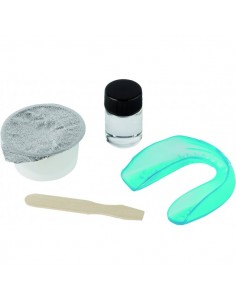
People who wear braces have the option of purchasing special boil-and-bite mouthguards. These are designed to enclose not only the teeth but also the wires of the braces. This prevents the braces from cutting into the sensitive oral mucosa. This special design is only available from specialist retailers and is therefore perfect for people who wear braces. Our PX mouthguardFor braces wearers consists of two different materials. The outer layer, which has no contact with the braces, does not change during fitting. The inner layer is customised to your braces to ensure a perfect fit and maximum protection.
Thermoplastic materials are able to change their shape when heated. However, the 2-component mouthguard with its hard shell is excluded from this. Alternatively, there is the mouldable mouthguard (custom fit), but the customisation is more complex. There is also the option of having a mouthguard made by a dentist. Although this option is somewhat more expensive, the mouthguard then fits perfectly to the individual shape of the jaw and teeth. This option is the preferred choice for professional athletes. However, the customisation process is usually only carried out once the jaw is fully grown and does not require constant adjustment. For a professional mouthguard of this type, you can expect to pay an investment of around 300 to approx. francs.
Tooth protection for children
What is indispensable for adults naturally also applies to Children. In boxing, a mouthguard is of the utmost importance - and the most important factor here is how well it fits. As a rule, most models are available in both adult and children's sizes. The mouthguard is usually only made by the dentist when the jaw is fully grown, as it is not necessary to constantly adjust the size. Adult models can usually be used from the age of 11 or 12.
We recommend the following models for children:
- Venum Challenger mouthguard for children
- Leone kids mouthguard Junior PD519J
Single or double face mask?
When buying a mouthguard, there is more to consider than just the material it is made of. It is also important to consider your individual needs. Consider whether a single mouthguard is sufficient or whether you need a double mouthguard.
The mouthguard only works if you clench your teeth firmly. A Double mouthguard can help to bring the rows of teeth closer together and thus provide more stability. However, the double mouthguard also requires practice.
There are individuals who, in combat situations or during training, can clench their teeth tightly with a double mouthguard and thus protect their rows of teeth.
Compared to a single mouthguard, the double mouthguard fits more firmly and therefore offers better support. However, it is also more expensive and only necessary if you wear braces at the top and bottom or need additional protection. The core of the double mouthguard has openings that allow the mouth to breathe comfortably. Nevertheless, it takes some practice to get to grips with it during training.
Cleaning and caring for your mouthguard
It is advisable to always store the face mask in a special cover or case when it is not in use. This protects the little helper from dirt and damage. To prevent any caries infections, the mouthguard should also be cleaned regularly under running, lukewarm water. A toothbrush and simple soap can be used for this, while toothpaste should be avoided due to the abrasive particles it contains. It is completely normal for light-coloured splints to discolour over time. In this case, it is merely a cosmetic problem and the mouthguard can usually be easily replaced. Replacement is also necessary if the guard is broken or otherwise damaged, no longer fits properly or no longer fits correctly due to the growth of the jaw (in children, for example).
Buy a face mask
In both amateur and professional sport, it is essential to wear a high-quality mouthguard. But what should you look out for if you want to buy a suitable mouthguard? Here are some key factors you should consider.
- Make sure that the material is of high quality
- A perfect mouthguard must fit perfectly and must not negatively affect your performance, mouth breathing or speech
- Good mouthguards are food-safe and completely free of harmful substances.
- A good mouthguard does not affect your bite or jaw position
Conclusion
Wearing a mouthguard is essential for anyone who enjoys sporting activities, be it boxing or kickboxing. There are various models that can be customised to suit individual needs. The Boile and Bite mouthguard can be easily customised at home, while the double mouthguard for the upper and lower jaw and the children's mouthguard have been specially developed for the needs of children. There are also special mouthguards for people with braces. The professional mouthguard, which is customised by a dentist, offers the highest level of protection and is therefore particularly recommended for professional athletes.
A good mouthguard is essential to prevent injuries to the jaw and teeth. The flexible material distributes the energy of the blow over a larger area and thus absorbs it. Correct use and adjustment of the mouthguard can even reduce the risk of concussion.
It should be a matter of course to wear a mouthguard for every sparring and boxing match. Even supposedly light blows can cause serious injuries. There are inexpensive versions, customisable models such as the Boile and Bite mouthguard and high-priced customised mouthguards. The Boile and Bite variants are well suited for hobbyists, while professional athletes who train frequently and take part in competitions are better off choosing a customised mouthguard from a dentist. Protect yourself and your teeth by not going without a mouthguard!
No sparring and no boxing match without a mouthguard! Even seemingly light blows can lead to serious injuries to the jaw and teeth, depending on the position of the head and the angle of the blow!!!
The text of the article is subject to the copyright of the author and may not be used by third parties!





Comments (0)