

Shopping Cart
There are no more items in your cart
- Vivien Rolf
- Training & Technology
- 0 likes
- 1171 views
- 0 comments
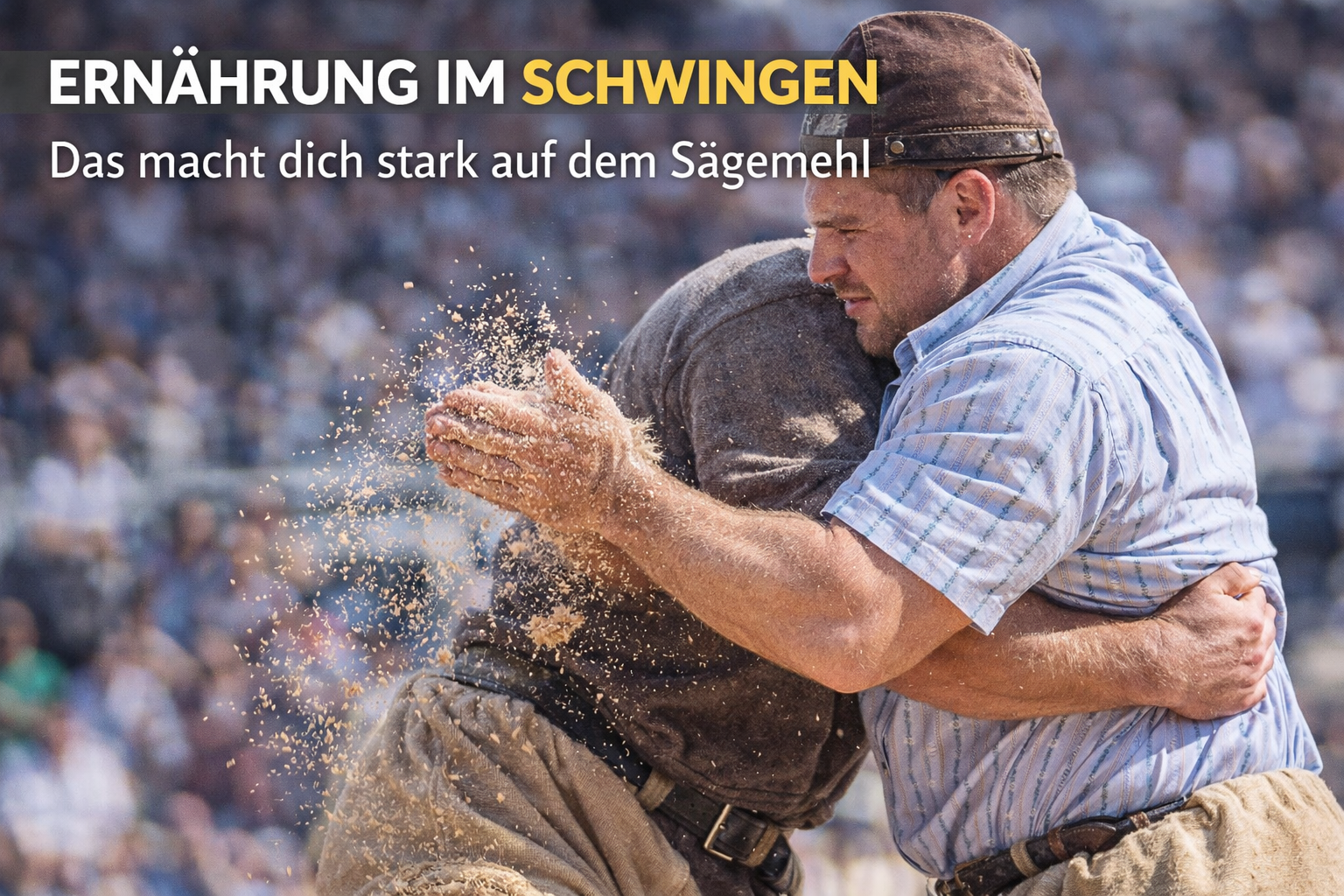
Schwingen is more than just a traditional sport – it is a piece of Swiss identity. In the sawdust ring, success depends not only on raw power but also on technique, conditioning, mental toughness, and above all, the mind. A Schwinger must be resilient, enduring, and able to think strategically. But what is behind the performance of these athletes?
The foundation lies in hard training, proper nutrition, and a mentality shaped by fairness and fighting spirit. On top of that come supplements that meet the high demands of training and competition. In this article, you will learn how Schwingers eat, think, and train – and how you can incorporate parts of their approach into your own training.
Nutrition in Schwingen
A Schwinger often weighs between 100 and 140 kilograms – not as excess weight, but as concentrated muscle mass with functional strength. Developing and maintaining this power requires a smart nutrition strategy.
Macronutrients in Focus
Proteins – the building blocks of muscles
After every training session, the body needs protein to repair and build muscle tissue. Schwingers traditionally rely on meat, fish, cheese, and milk. But with multiple training sessions per week, these sources are often not enough. This is where protein powder comes into play:
Whey protein for rapid supply after training
Casein as a night-time protein for continuous amino acid delivery during sleep
Carbohydrates – the fuel for explosiveness
Schwingen is a sport of short, extremely intense bursts. The body needs fully stocked glycogen stores. Staples include potatoes, pasta, bread, and oats. A Schwinger may consume 5000 to 7000 calories per day – without carbs, there is no fuel.
Fats – underestimated but essential
Nuts, seeds, rapeseed oil, or fish provide Omega-3 and Omega-6 fatty acids. They protect joints, stabilize hormones, and deliver energy during long competition days.
Micronutrients and Hydration
Schwing festivals often last the entire day, sometimes in hot conditions. The body loses not only water but also vital minerals. Magnesium, potassium, and sodium must be replenished – otherwise cramps are inevitable.
· Electrolyte drinks or mineral powders are essential here
· Multivitamins help close possible gaps if the diet is unbalanced
Supplements in Schwingen
The difference between training and competition often lies in the details. Those who support themselves smartly have more energy for longer and recover faster.
Useful Supplements for Schwingers
· Protein (whey, casein, multi-component) – muscle protection and fast recovery
· Creatine – scientifically proven to increase explosive strength in short, intense efforts
· BCAA/EAA – prevent muscle breakdown during long competition days
· Beta-alanine – improves buffering capacity against acid build-up (only in permitted Swiss products such as tablets or capsules)
· Magnesium & electrolytes – prevent cramps and promote muscle relaxation
· Omega-3 – anti-inflammatory, supports joints and cardiovascular health
· Vitamin D – particularly important in Switzerland, where many athletes get too little sunlight during winter months or when training indoors
Supplements with Balance
A Schwinger does not live on powders alone. Supplements should be an addition to nutrition, not a shortcut. Quality and digestibility are what matter – products that make sense without unnecessary gimmicks.
Mental Strength in Schwingen
A Schwinger competes not only with muscles but also with the mind. Standing in the sawdust means facing pressure – from spectators, opponents, and expectations.
Focus and Calm
A Schwinger must be fully concentrated at the right moment. One grip, one move, a split second decides victory or defeat. Mental training – breathing techniques, visualization, and routines – are just as important as strength training.
Tradition and Values
Schwingen thrives on respect. After a bout, the winner brushes the sawdust off the loser’s back. This gesture symbolizes fairness and camaraderie – values that can also be carried into the gym and everyday life.
Perseverance
Not every bout is won. Defeat is part of the sport – what matters is how you come back. The Schwinger mentality offers a lesson for every athlete: fall down, get back up, keep going.
Team Spirit Despite Individual Competition
Schwingen is man against man – yet training is done in clubs. Community, mutual support, and exchange are what make the sport strong.
Training Like a Schwinger – Lessons for Fitness and Combat Athletes
Even if you are not a Schwinger, you can take away valuable lessons for your own training:
· Functional strength exercises such as squats, deadlifts, and power cleans form the foundation
· Core training is essential for any throwing movement
· Explosive power can also be trained in the gym with plyometrics or Olympic lifts
Mental routines improve your performance – whether in the ring, in the gym, or on the mat
Conclusion
Schwingen is a sport of extremes – and a reflection of discipline, tradition, and power. To train like a Schwinger, you need not only muscle strength but also a smart nutrition plan, targeted supplements, and the right mental attitude.
Whether in the sawdust, in the gym, or in the boxing ring: the combination of physical strength, mental toughness, and smart nutrition is the key to success.
Image Notice:
The images used in this article were created with the help of artificial intelligence (AI). The people shown are entirely fictional and do not represent real athletes.
Of course, we would prefer to show real fighters and athletes. However, professional sports photos often come with very high licensing costs and can quickly reach several hundred Swiss francs per image. In order to keep our content freely accessible, we occasionally use AI-generated illustrations.

Comments (0)