Martial arts for children and teenagers
Is it sensible or dangerous to let my child learn martial arts such as taekwondo?
It's never too late to learn martial arts. It is better to start training from an early age. In this article, we show you why martial arts can be good for children and young people.
Helpful defence or unnecessary brutality?
Most parents always have concerns about martial arts when it comes to their own children. They ask themselves questions such as "Are they learning how to defend themselves or rather how to fight better in the schoolyard?
When should children start martial arts?
The same rule that applies to adults also applies to children. You are never too young or too old for martial arts, as there are different martial arts. There is something for every age group. Criteria such as intensity or type of training can be customised. As soon as children are old enough to take part in sport, martial arts can also be an option for them. There are even clubs in Germany where children can start martial arts from the age of three.
Which martial arts are suitable for children and young people?
Most clubs that specialise in taekwondo, judo, jujtsu, karate or kickboxing offer training for children. Once the child is registered, it is categorised in the correct age group. It is generally not possible to say how well trained the instructors are or how playful or technical the training is for the little ones. It usually helps to enrol the child on a trial basis and observe the training yourself.
The choice of martial arts depends on the character
In order to decide which martial art is suitable for children, you need to know the character traits of the child well. Then you can enrol them in the right club. For example, if the child is hyperactive and not shy, it is worth enrolling them in martial arts clubs that practise karate, kickboxing or taekwondo. If the child is more reserved and shy, it is advisable to start with judo training and observe the development first. If a child doesn't want to know anything about martial arts, it's not worth forcing it on them. Such children usually don't enjoy training.
Of course, it is also important to find out which martial arts are offered in the neighbourhood. Public schools usually charge higher prices for training than clubs. It's worth finding out and comparing.
Why should children train in martial arts?
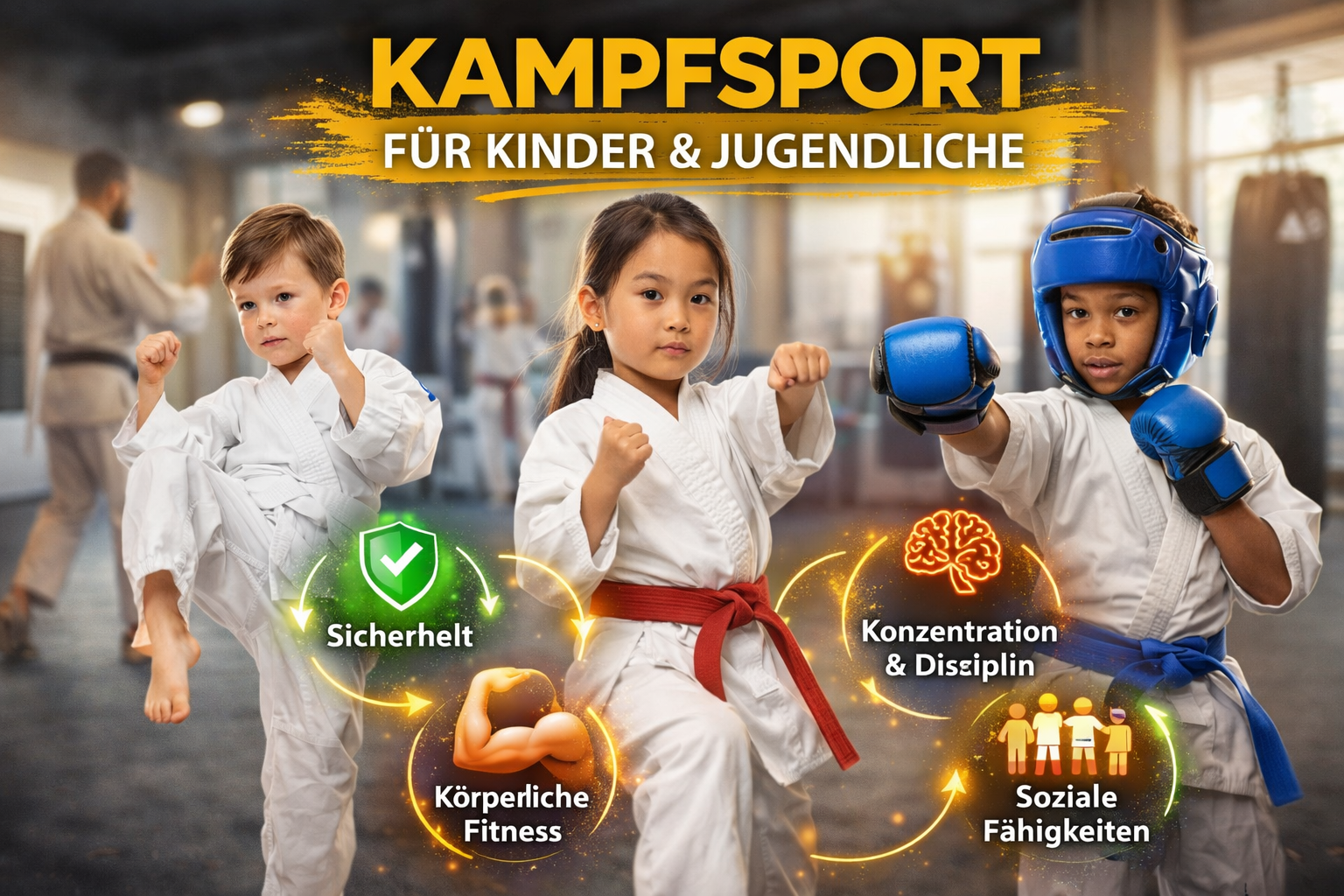
Children are not interested in learning and perfecting techniques. Therefore, martial arts training for children can be seen as a kindergarten that prepares children for school. Martial arts training in childhood trains the prerequisites for later learning and behaviour, both in sport and in everyday life. The physical aspects are gradually introduced. The child is taught exercises for their own body awareness and body tension without injuring or overstraining the child's body. Over time, the integrated strength training helps the child to develop an upright posture. The child appears more secure and self-confident.
The risk of injury is low
In sports such as judo, children learn how to catch themselves properly in the event of a fall, for example. Such training exercises take place on a well-padded wrestling mat. Through the trainer, they get to know their own body and become more aware of it. If you compare martial arts training with ball sports such as football, the risk of injury is much lower. Young children have the opportunity to let off steam and overcome any shyness they may have. Social contact is encouraged.
Another advantage for the child's early education is discipline. As a rule, most martial arts teach children to follow certain rules from the outset, be it the traditional greeting, clean clothing or silence when the trainer explains something.
Successes for children
More and more martial arts schools are organising internal or even external championships. Slightly older children, usually from the age of six, can take part in the competitions to measure themselves against others and test their own level of performance. They learn to fight against others according to strict rules. Success is achieved through clean techniques, not indiscriminate strikes.
There are also various categories at the championships in which competitors can measure themselves, such as form running, "kata" in karate or the so-called "pumse" or "hyong" in taekwondo. The aim of this form is to perform the techniques learnt in a clean sequence. Points are awarded by several judges.
If the children decide against travelling to a tournament, they also have the opportunity to achieve other successes in martial arts. The next belt is achieved in many of the martial arts, usually via a small test for which the children train.
Martial arts strengthens self-confidence and prevents violence in everyday life
Every day we hear worrying stories about bullying and violence in schools. The sad news for us is that this is also the reality. Martial arts is the perfect tool for children to assert themselves, be more self-confident and, above all, to say "no". This does not mean that they are trained to hit back directly, but that they are less exposed to the danger of being victimised.
Conclusion
To summarise, it can be said that martial arts makes it clear to children what violence is and what effects violence has. If you see that your child is interested in practising martial arts, it is worth encouraging them and giving them the chance. The motto is: "The real art is to avoid the fight".








Comments (0)